 Save
Save My cousin showed up at my apartment on a humid summer evening with a bag of fresh herbs and a mission: teach me how to make spring rolls that didn't fall apart. We spent an hour laughing at my clumsy first attempts, rice paper sticking to everything but my hands, until something clicked and the rolls started coming together like little edible presents. Now whenever I make them, I can still hear her saying the water shouldn't be hot, just warm enough to soften without cooking, and somehow that simple detail changed everything.
I made these for a potluck where everyone brought heavy casseroles, and watching people's faces light up when they bit into something fresh and bright instead of warm and dense felt like I'd cracked some kind of code. The rolls disappeared faster than everything else, and someone actually asked for the recipe written down, which almost never happens at these things.
Ingredients
- Rice paper wrappers: These are the silky foundation of everything, and they're more forgiving than they look once you get the water temperature right—too hot and they tear, too cold and they stay stiff and stubborn.
- Cooked chicken breast, shredded: Use rotisserie chicken if you're short on time; the slight smokiness actually adds character.
- Carrots, julienned: The bright sweetness cuts through the richness of the peanut sauce and adds a satisfying crunch.
- Cucumber, julienned: This is what keeps spring rolls from feeling heavy; it adds coolness and a clean finish.
- Red bell pepper, thinly sliced: Beyond just looking beautiful, it brings a subtle sweetness that balances the savory and spicy notes.
- Lettuce leaves, torn: A bed of lettuce keeps everything from getting soggy and adds texture contrast.
- Fresh mint leaves: Don't skip this—it's the unexpected note that makes people ask what makes these different from other spring rolls.
- Fresh cilantro leaves: If cilantro is your thing, embrace it; if it tastes like soap to you, honestly just use more mint instead.
- Green onions, sliced thin: They add a little sharpness that wakes everything up.
- Creamy peanut butter: Natural or conventional both work, but make sure it's actually creamy and not the super thick kind.
- Soy sauce: This is your umami anchor; tamari works beautifully if you need gluten-free.
- Fresh lime juice: Bottled works in a pinch, but fresh makes you taste the difference immediately.
- Honey or maple syrup: Just enough to round out the edges and make the sauce feel complete.
- Sesame oil: A little goes a long way; this is what makes people say the sauce tastes restaurant-quality.
- Warm water: This is your adjustment tool for sauce consistency, so add gradually.
- Garlic, minced: Fresh garlic scattered through the sauce gives it personality.
- Fresh ginger, grated: The brightness here is what keeps the sauce from tasting one-note.
- Sriracha or chili sauce: Optional, but if you like heat, this finishes strong without overpowering.
Tired of Takeout? 🥡
Get 10 meals you can make faster than delivery arrives. Seriously.
One email. No spam. Unsubscribe anytime.
Instructions
- Set up your station like you mean it:
- Lay out all your vegetables and herbs on a platter within arm's reach—this is genuinely important because once you start rolling, you won't want to be hunting around your kitchen. Having everything prepped and visible makes the whole process feel organized instead of chaotic.
- Get your water right:
- Fill a shallow dish with warm water, not hot—if it's too warm it cooks the wrapper, too cool and it stays stiff. You'll figure out the sweet spot after dunking the first one; trust your hands more than the timer.
- Soften one wrapper at a time:
- Submerge it for about 10 to 15 seconds, then lay it flat on a clean, damp kitchen towel where it will continue softening as you work. This is where patience actually pays off.
- Build your roll with intention:
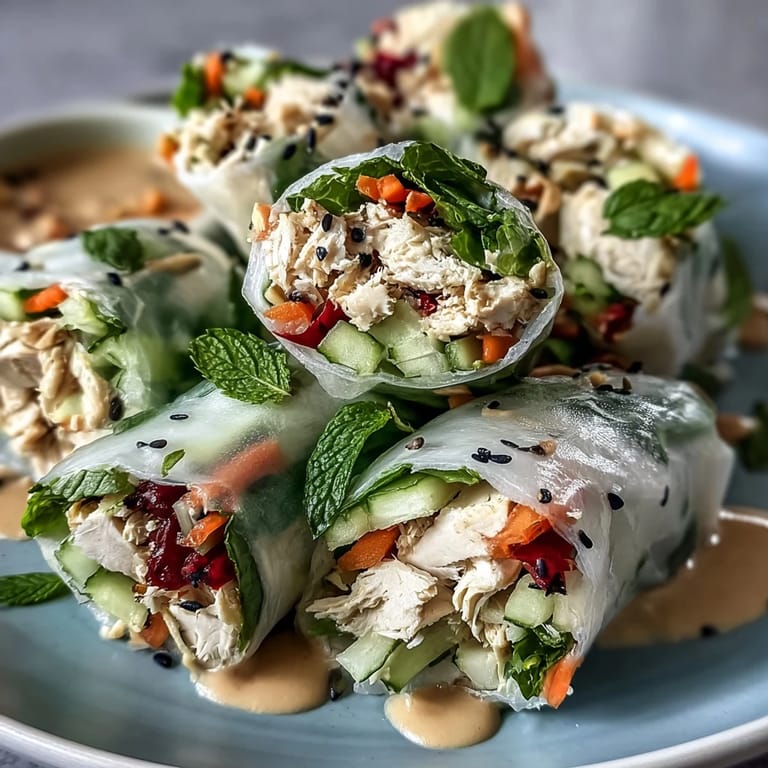
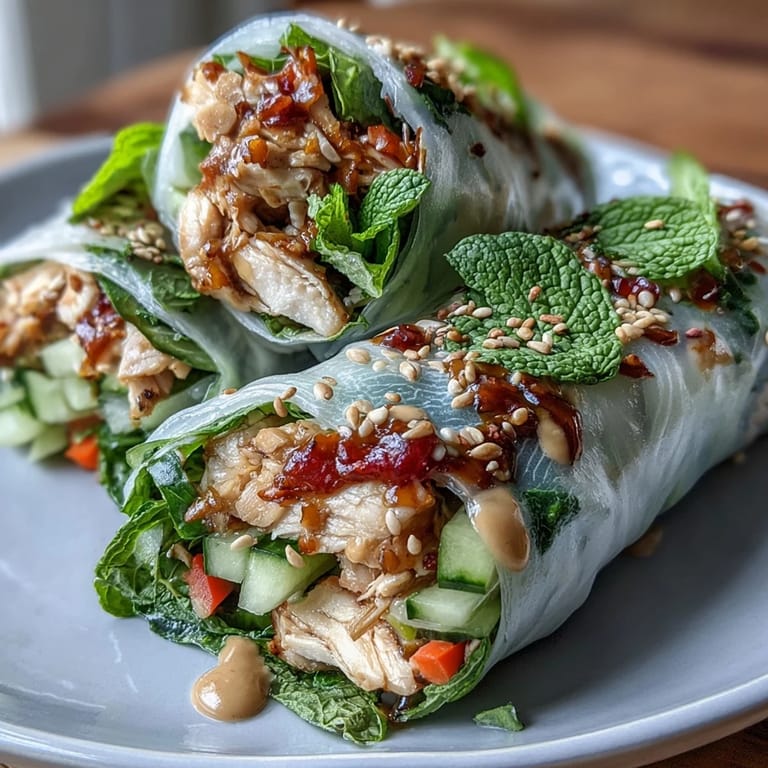
- Place a small handful of lettuce first as your base, then layer chicken, carrots, cucumber, bell pepper, mint, cilantro, and green onion along the bottom third of the wrapper. Think of it as creating a little edible garden in there.
- Roll like it owes you money:
- Fold the bottom edge over the filling, then fold in the sides and roll tightly like a burrito, keeping tension as you go. If it's loose it will fall apart when you eat it, but if you've done it right it holds together with this satisfying integrity.
- Make the sauce with rhythm:
- Whisk peanut butter with soy sauce, lime juice, honey, and sesame oil in a small bowl, then add garlic and ginger and that optional Sriracha if you're feeling it. The warm water is your secret weapon for getting it smooth—add it slowly while whisking until it's pourable but still substantial.
- Taste as you go:
- The sauce should make you smile a little when you taste it; if it needs more lime, add more lime, if it needs more heat, add heat. This is your moment to make it yours.
- Serve with no apologies:
- Arrange rolls whole or sliced in half with the sauce nearby for dipping, and eat them within a few hours while the wrappers are still tender. They're best right away, when everything still tastes fresh and promising.
 Save
Save There's something almost meditative about rolling these, the repetition of fold and tuck, watching something come together piece by piece with your own hands. I made them the night before my birthday and just sat on my kitchen counter eating them while listening to music, and it felt like a celebration before the celebrating even started.
When to Make These
Spring rolls are your answer when you want something that tastes special but doesn't require a dramatic amount of skill or time. They're perfect for warm weather when you don't want anything heavy, for showing off in front of people without actually stressing, or for that moment when you're craving something fresh and a little bit fancy but mostly you just want to eat something that tastes good.
Building the Perfect Ratio
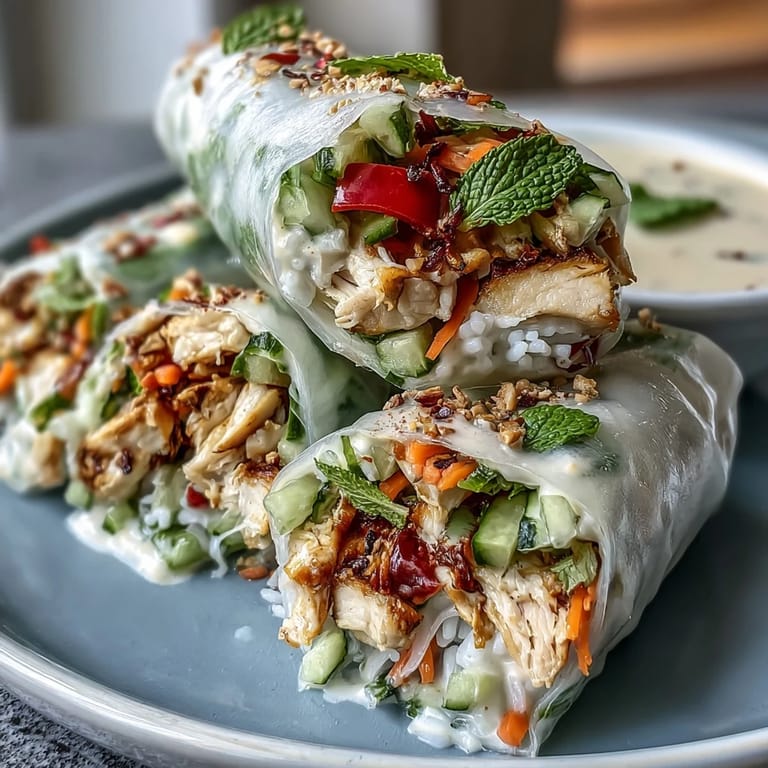
The magic of spring rolls isn't in having the most filling; it's in the balance between textures and flavors in each bite. I used to overstuff mine thinking more was better, but that just made them hard to roll and kind of overwhelming to eat. Once I scaled back and focused on proportion—a little chicken, a little of each vegetable, a whisper of herb—they became something I actually wanted to eat three of instead of just one.
Variations and Personal Touches
These rolls are genuinely flexible if you want them to be, and sometimes that's where the fun happens. I've made them with shrimp when I wanted to feel fancy, with just vegetables when my vegetarian friend came over, and once with thin vermicelli noodles mixed in because someone mentioned they liked them heartier and I was curious. The peanut sauce is also your playground—add more ginger if you like heat, more lime if you want brightness, swap in almond butter if peanuts aren't your thing.
- Vegetarian swaps work beautifully here; tofu or extra vegetables fill the space chicken leaves just fine.
- Vermicelli noodles add substance without heaviness if you want these to feel more like a meal.
- Don't be afraid to taste and adjust the sauce until it tastes like something you'd actually want to eat.
 Save
Save These spring rolls became something I make whenever I want to feel capable and present in my kitchen, and they remind me that sometimes the simplest things, done with a little attention and care, become exactly what people remember. They're proof that you don't need a complicated recipe to make something worth eating.