 Save
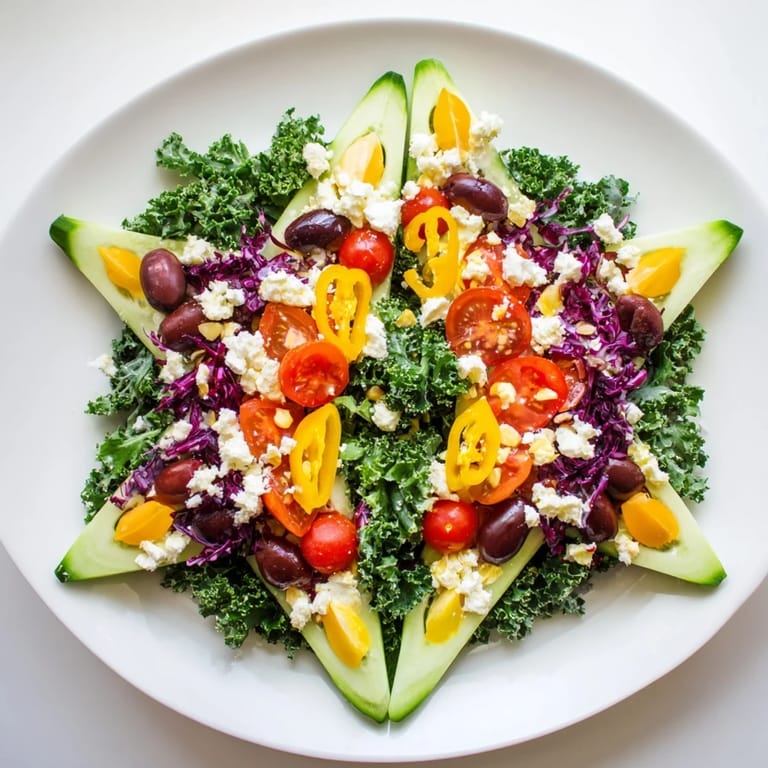
Save I first fell in love with the Star of David salad platter during a Hanukkah celebration at my cousin's house years ago. As I walked into her kitchen, there it was on a massive wooden board—this breathtaking arrangement of jewel-toned vegetables perfectly arranged in that iconic six-pointed star. She caught me staring and laughed, saying it took her just thirty minutes but looked like she'd spent all day. That moment changed how I thought about salads. They didn't have to be tossed in a bowl and forgotten. They could be art, storytelling, celebration all on one platter.
I still remember my partner's face the first time I made this for him. He came home from work, walked past the dining room, and actually gasped. Not because the food was revolutionary, but because someone had taken the time to make something beautiful just for the meal. We spent an extra twenty minutes just admiring it before we ate, taking photos, telling stories. That's when I realized this salad does something special—it transforms a regular dinner into a moment worth remembering.
Ingredients
- Baby spinach and arugula: These tender greens form your foundation and are more forgiving than delicate lettuces. The slight peppery bite of arugula plays beautifully against the mild spinach. Buy pre-washed if time is tight, but gently dry them so they stay crisp throughout the meal.
- Cucumbers: Slice these thin so they drape gracefully as your star's outline. English cucumbers have fewer seeds and look cleaner, but regular ones work beautifully too. The thin slices catch light and make the geometry pop.
- Cherry tomatoes: Halved rather than whole, they nestle into the star's sections perfectly. Choose tomatoes that are just ripe, not soft—they'll hold their shape through assembly and stay fresh longer.
- Bell peppers (yellow and red): These aren't just flavor, they're your color statement. The contrast between sunny yellow and passionate red is exactly what draws the eye to your star. Slice them into thin strips that follow the geometric lines.
- Purple cabbage: This brings an earthy sweetness and that gorgeous jewel tone. Shredding it finely makes it behave like confetti when you fill the star's sections, catching light at different angles.
- Red onion: Optional, but I always add it. Raw onion brings a sharp brightness that wakes up all the other flavors. Just slice paper-thin so it's more whisper than shout.
- Feta cheese: Crumbled into rough chunks, it adds creamy saltiness and visual texture. If you're dairy-free, cashew feta is remarkably convincing and holds up beautifully.
- Kalamata olives: These briny, dark jewels anchor the flavor and create visual weight at the star's points. Halving them prevents them from rolling around mid-presentation.
- Capers: Small bursts of salty tang. They're optional, but they add sophistication and make people wonder what that bright flavor is.
- Pine nuts: Toasted before scattering—this matters. Toasting releases their buttery essence and gives them a deeper color. They add both crunch and elegance.
- Extra virgin olive oil: Quality here makes a difference. This is your finishing touch, so don't use the everyday bottle.
- Lemon juice and red wine vinegar: Together they create brightness without overpowering the delicate greens. Fresh lemon juice makes a real difference—bottled tastes flat by comparison.
- Honey or maple syrup: A touch of sweetness balances the vinegar's punch. It also helps the dressing emulsify, creating something that clings gently to each leaf.
- Dijon mustard: An emulsifier and flavor booster. It anchors the dressing, making it coat everything evenly rather than pooling at the bottom.
Tired of Takeout? 🥡
Get 10 meals you can make faster than delivery arrives. Seriously.
One email. No spam. Unsubscribe anytime.
Instructions
- Gather your canvas:
- Start with the largest flat platter or serving board you own. You want space to work and room for the star to breathe. If you're nervous about the geometry, lightly sketch the star with a toothpick before you start arranging—no one will see the guides once the greens are down.
- Create your green foundation:
- Lay down the spinach and arugula in a thin, even layer across the entire platter. Use your fingers to arrange them so they look organic and intentional, not pressed down. This base is your canvas—it should look inviting and fresh.
- Map your star:
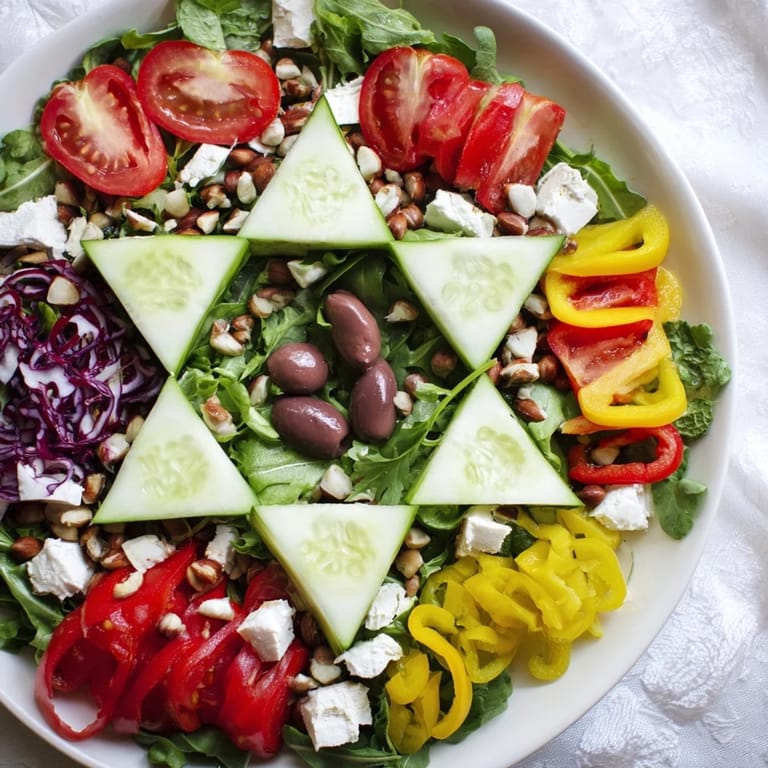
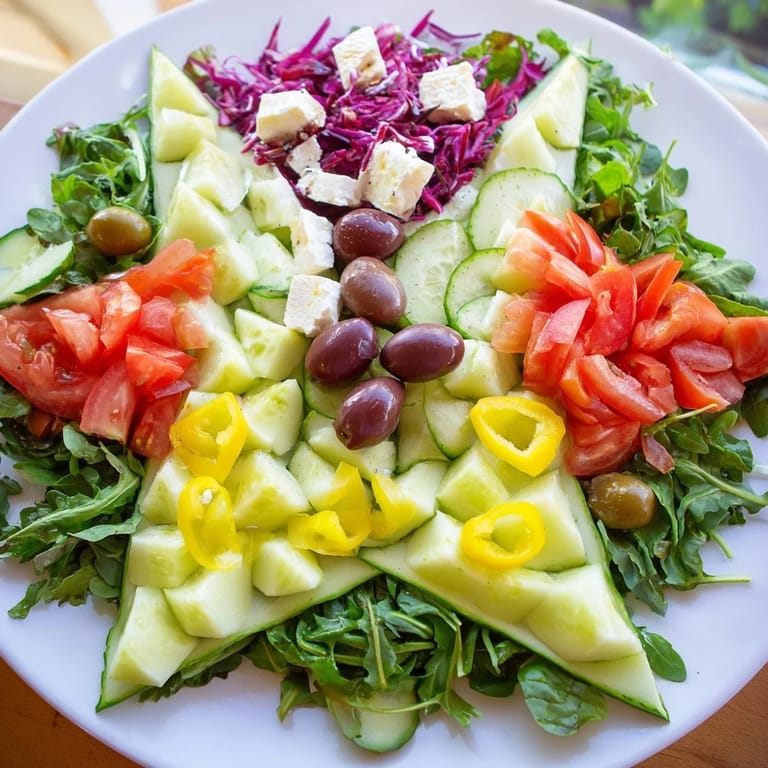
- Now for the moment of truth. Take your cucumber slices and arrange two overlapping equilateral triangles. Think of it like drawing on the platter. One triangle points up, one points down. The overlap creates those six clean points. Step back frequently to check your angles. Imperfection is charming, but geometry matters here for the visual impact.
- Fill the sections:
- Between the cucumber lines, you now have six triangular sections. Start filling them strategically with groups of tomatoes, bell peppers, and purple cabbage. Create visual contrast—put the yellow peppers next to the red ones, cluster the tomatoes, make the purple cabbage sections pop. Think of it like coloring a canvas. Each section should feel intentional and beautiful.
- Add the finishing touches:
- Scatter feta cheese crumbles along the cucumber edges and at the star's points. Nestle the halved olives into corners. Sprinkle capers if you're using them. Finally, dust with toasted pine nuts. These elements add dimension and texture, making the star feel rich and complete.
- Make your dressing:
- In a small bowl, whisk together the olive oil, lemon juice, vinegar, honey, and mustard. The mustard is key—it'll help everything emulsify into a silky dressing rather than separating. Taste it before you finish. Does it need more acid? More salt? Adjust to your preference. Season with kosher salt and fresh pepper just before using.
- The moment of truth:
- You can either drizzle the dressing gently over the entire platter right before serving, or place it in a small bowl alongside. If you're serving within the hour, drizzle away. If it's going to sit, keep the dressing separate so the salad stays crisp and the star stays defined.
- Serve and celebrate:
- Bring it to the table with some fanfare. Let people admire it for a moment. There's something about homemade food arranged with intention that makes everyone at the table feel seen and celebrated.
 Save
Save My favorite moment with this salad happened at a potluck where someone's teenage daughter said, 'Wait, you made this? It's so beautiful I thought it came from a catering company.' Her mom beamed. That's what this recipe does—it gives you permission to be an artist in your own kitchen, and it lets the people you feed know that you see celebrations as worth the extra care.
The first time you make this, you might feel a little nervous about the geometry. Don't. The secret is that human eyes are forgiving, and the colors do most of the work for you. I actually found that thinking about it like painting helps more than thinking about it like geometry. You're not trying to create a perfect mathematical shape—you're creating the impression of one using nature's own palette. The cucumber outline becomes your pencil sketch, and everything else is the color that brings it to life.
This is the kind of recipe that rewards preparation without demanding it. You can wash and dry your greens the morning of, slice your vegetables an hour ahead, and make your dressing while the platter is still in the cabinet. Then, about thirty minutes before you want to serve, you lay down the greens and arrange everything. The whole assembly takes about fifteen minutes once you get the hang of it. This means you're not stuck in the kitchen while your guests arrive—you're with them, and then you unveil something special.
While this recipe feels special as written, the true magic is that it's infinitely adaptable without losing its soul. In summer, when heirloom tomatoes are at their peak, use those instead and let their colors guide your color choices. In winter, add shredded beets for deep burgundy, or roasted sweet potato for warm orange. You could scatter chickpeas for protein and earthiness, or add grilled chicken strips if you want something heartier. The framework stays the same—greens, outline, colored sections, finishing touches—but the specific players can change with seasons and moods.
- Add protein like chickpeas, grilled chicken, or hard-boiled eggs if you want to make it a main course instead of an appetizer
- Make it dairy-free by using cashew feta or simply omitting the cheese entirely—the salad is still stunning
- Double the dressing recipe if you like everything well-coated, or keep it on the side if you prefer your greens drier and crisper
 Save
Save This salad, more than almost any recipe I make, reminds me why we cook for each other. It turns dinner into a moment, and it says something wordless but profound about care. Make it, and watch what happens.
Recipe FAQs
- → How do you create the Star of David shape with cucumbers?
Use thinly sliced cucumber pieces to outline two overlapping equilateral triangles on the platter, adjusting the angles carefully to maintain the six-pointed star shape.
- → Can I substitute any ingredients for dietary preferences?
Yes, vegan feta cheese can replace traditional feta, and pine nuts can be omitted for nut allergies. Additional protein can be included by adding chickpeas or grilled chicken if desired.
- → What is the best way to dress the salad platter?
Whisk together olive oil, lemon juice, red wine vinegar, honey or maple syrup, Dijon mustard, salt, and pepper until emulsified, then drizzle evenly just before serving.
- → How should I prepare the greens for this platter?
Wash and dry baby spinach and arugula leaves thoroughly, then arrange them in a thin, even layer as the base covering the serving platter.
- → Are there tools to help shape the triangles accurately?
Using cookie cutters or templates can assist in guiding the cucumber slices to form clean, geometric triangles for the star.